

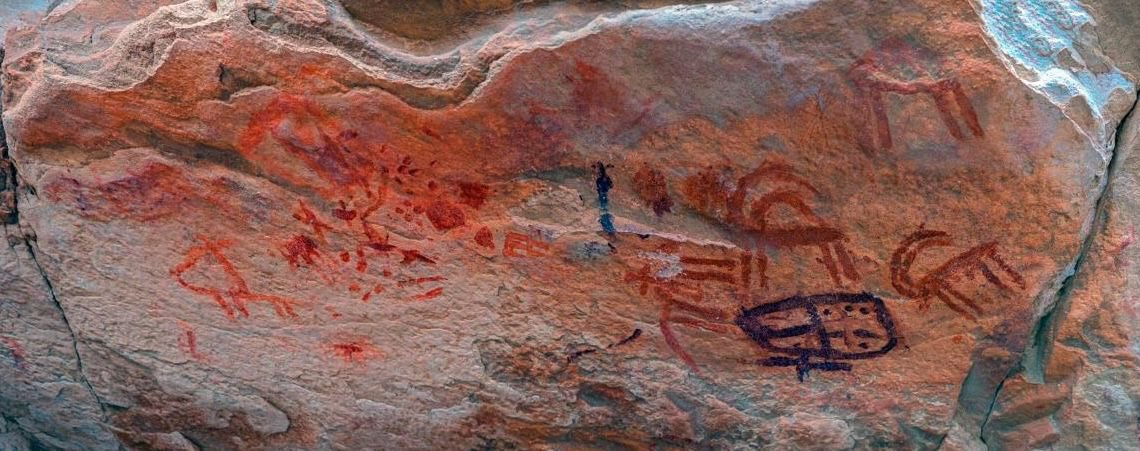
CAIRO (SCANS) — Egypt’s Ministry of Tourism and Antiquities on Saturday announced the discovery of a vast rock shelter on the Umm Arak Plateau in the Eastern Desert, revealing a gallery of prehistoric and later art that offers a window into 10,000 years of human activity in the region.
The site, a 100-meter-long sandstone shelter, features vivid red and gray paintings depicting hunters, animals, and abstract symbols, which officials say date back to the early Holocene epoch, roughly 10,000 years ago. Superimposed on these older works are later carvings of camels, horses, and inscriptions in Arabic, providing a timeline of shifting civilizations and environmental changes in the arid landscape.
“This is a significant find that tells the story of continuous human presence in this harsh environment,” said Dr. Mustafa Waziri, Secretary-General of the Supreme Council of Antiquities, in a statement. “The site was a gathering place, a canvas for expression for millennia.”
The discovery was made by an Egyptian archaeological mission operating in the area. The Umm Arak Plateau is a remote area known for its rugged terrain and wadis, located within the governates of Luxor and the Red Sea, an area historically used as a trade and quarrying route.
In addition to the art, the mission uncovered a collection of stone tools and pottery fragments. Archaeologists have preliminarily dated these artifacts from the Middle Kingdom period (circa 2050–1710 B.C.) through the Roman era (30 B.C. – A.D. 640), corroborating the theory that the shelter was used repeatedly over thousands of years as a waystation or a communal hub for nomadic groups and travelers.
The images of hunters and wild animals in the oldest layers of paint are consistent with a period when the now-desert region was a savanna-like environment that supported abundant wildlife and human habitation. The later carvings of domesticated animals like camels and horses reflect the region’s evolution into a critical artery for trade and transport, connecting the Nile Valley with the Red Sea coast.
The announcement has been met with keen interest among archaeologists specializing in rock art. While the Eastern Desert is known to contain thousands of petroglyphs and inscriptions, a site with this level of layering and longevity is considered rare.
“Finding a palimpsest—where one generation draws over the last—like this in such a stratified context is incredibly valuable,” said Dr. Salima Ikram, an Egyptologist at the American University in Cairo, who was not involved in the excavation. “It allows us to potentially trace not just artistic styles, but also changes in belief systems, fauna, and climate adaptation over a vast span of time.”
The Ministry stated that documentation and conservation work at the site are ongoing. The remote location of the plateau presents challenges for tourism, but officials plan to create detailed digital records of the art for study and eventual public dissemination. The discovery adds a new chapter to the understanding of prehistoric and historic populations in the Eastern Desert, an area that served as a vital cultural corridor for ancient Egypt and its neighbors.