
KANO, Nigeria (SCANS) — A massive fire tore through the Gidan Glass section of Kano’s historic Singer Market on Saturday, marking the second catastrophic blaze to hit the commercial hub in less than two weeks and deepening an economic crisis in northern Nigeria’s largest city.
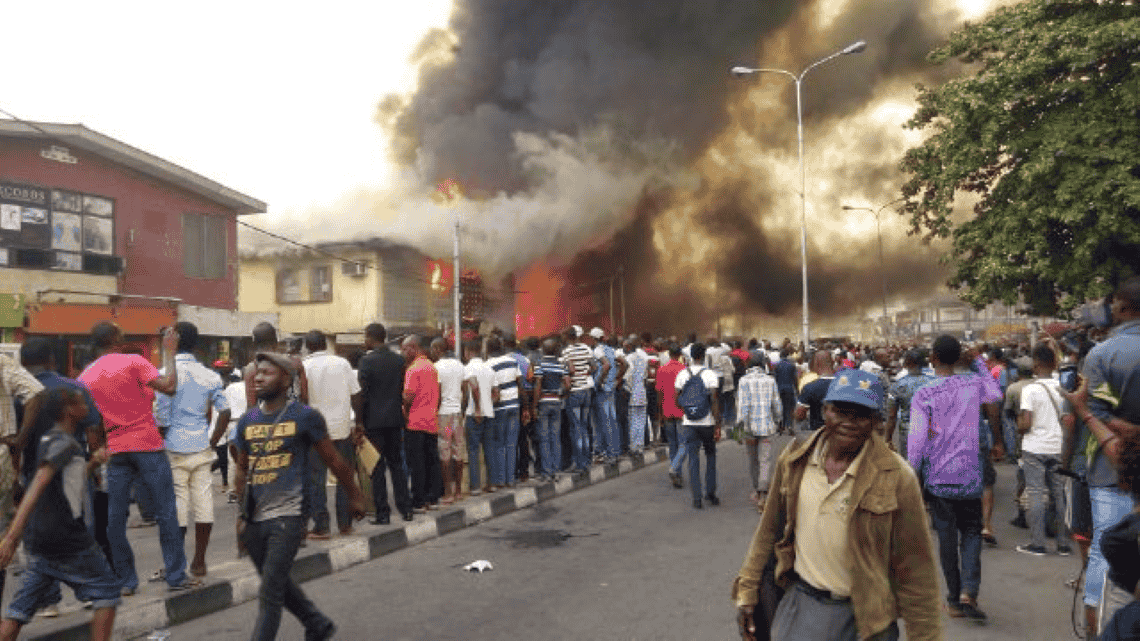
The fire, which erupted Saturday afternoon along the bustling Ado Bayero Road, completely engulfed a two-story commercial building.
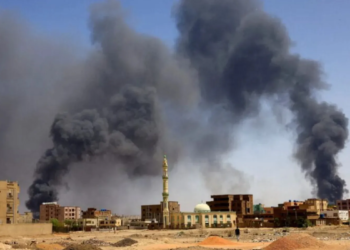
Thick plumes of black smoke could be seen for miles across the city as emergency responders and local volunteers struggled to contain the flames.
Eyewitnesses described the scene as chaotic, noting that the intensity of the heat and the speed of the spread appeared even more severe than a similar outbreak earlier this month.
The Saturday blaze follows a devastating fire on Feb. 2 that razed several multi-story structures within the same market, including the well-known Mazaf House and the Gidan Mangaro section.
Traders and local officials estimated that the Feb. 2 incident alone resulted in the loss of goods worth over ₦2 billion ($1.3 million USD).
The recurring disasters have sparked a sense of desperation among the merchant class in Kano, a city that serves as a vital trade link between Nigeria and Sahelian neighbors like Niger and Chad.
“We are watching our livelihoods turn to ash,” said Sani Isah, a local trader. “Before we can even calculate the losses from two weeks ago, the fire is back. It feels like a plague.”
The crisis is not limited to Singer Market. Just one week after the Feb. 2 incident, a separate fire razed the Kano Timber Market, destroying massive stockpiles of wood and equipment.
This pattern of destruction extends back several months; in November 2023, yet another fire at Singer Market destroyed 44 shops, an event that at the time was considered a major setback but has since been eclipsed by the February disasters.
While fire officials have not yet released an official cause for the most recent outbreak, previous investigations into Kano’s market fires have frequently pointed to a combination of aging electrical infrastructure, the use of private generators, and the highly congested nature of the stalls, which often prevents fire engines from reaching the heart of the blaze.
The timing of these fires—occurring during the peak of the Harmattan season, characterized by dry, dusty winds from the Sahara—has exacerbated the risk. The low humidity and high winds allow small sparks to transform into uncontrollable infernos within minutes.
Kano State authorities have faced increasing pressure to modernize the city’s markets and improve emergency response times.
While the State Fire Service has been praised for its bravery, traders have criticized the lack of functional hydrants and the slow arrival of water tankers in the narrow, overcrowded alleys of the commercial district.
As the smoke cleared Saturday evening, hundreds of traders stood at the perimeter of the police cordons, waiting to see if anything could be salvaged from the ruins of Gidan Glass.
For many, the recurring fires represent more than a series of accidents; they are a systemic threat to the economic heartbeat of Northern Nigeria.