
LAGOS, Nigeria (SCANS) — The low metallic hum of excavators vibrating across the lagoon was the only warning Victor Ahansu had before his world began to collapse.
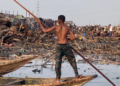
By the time the sun rose over the historic waterfront community of Makoko, the wooden stilts supporting his home had been splintered into the gray waters. Now, Ahansu, his wife, and their five-month-old twins live in a wooden canoe, shielded from the tropical rain by nothing more than a woven plastic sack.
“They told us to leave, but they didn’t tell us where to go,” said Ahansu, gesturing toward the floating wreckage of what was once a bustling neighborhood.
The demolition of Makoko, a centuries-old settlement often nicknamed the “Venice of Africa,” marks the latest and most aggressive chapter in the Lagos state government’s push to transform Nigeria’s commercial capital into a modern “mega-city.” Since late December, authorities have razed more than 3,000 homes, schools, and clinics, displacing an estimated 10,000 residents, according to local advocacy groups.
A Clash of Safety and Survival
The Lagos state government maintains the evictions are a matter of public safety. Officials argue that structures had encroached dangerously close to high-tension power lines and vital waterways near the Third Mainland Bridge, the city’s main artery.
“No responsible government can allow people to live directly under high-tension cables,” said Gbenga Omotoso, Lagos State Commissioner for Information. “This is about urban renewal and better living conditions. We are saving lives from potential calamity.”
However, residents and human rights groups tell a different story. They allege that while the government initially set a 100-meter safety corridor, bulldozers pushed as far as 500 meters into the community, destroying homes far beyond the reach of power lines.
Gentrification Fears
The displacement has sparked a familiar outcry in a city where land is the ultimate currency. With a population nearing 25 million, waterfront property in Lagos is prime real estate. Residents fear the “safety” narrative is a smokescreen for luxury development.
“This is a community that has existed for generations,” said Nnimmo Bassey, executive director of the Health of Mother Earth Foundation. “Destroying it is a shame on Nigeria. The government is acting in connivance with private interests to dispossess the urban poor.”
Humanitarian Crisis on the Water
The fallout has been swift and severe:
* Homelessness: Thousands are now sleeping in canoes or crowded into the remaining shanties of neighbors.
* Education Halted: At least two schools were demolished, leaving over 1,000 children without a classroom.
* Casualties Reported: Rights groups claim at least 12 people, including two infants, have died due to the stress of displacement or the alleged use of tear gas during the operations.
Following weeks of protests that saw fishermen taking to the lagoon in their boats to demand peace, the Lagos State House of Assembly ordered a temporary halt to the demolitions on February 9. A tentative five-point agreement was reached this week, promising a “10-man committee” to oversee compensation and a “Water City” regeneration project that the government claims will include the current residents.
For Ahansu and his twins, the promises of future “regeneration” offer little comfort against the immediate reality of life on a boat.
“We are humans,” an elderly woman in the community said in the local Egun dialect. “We just want a place to stand.”