
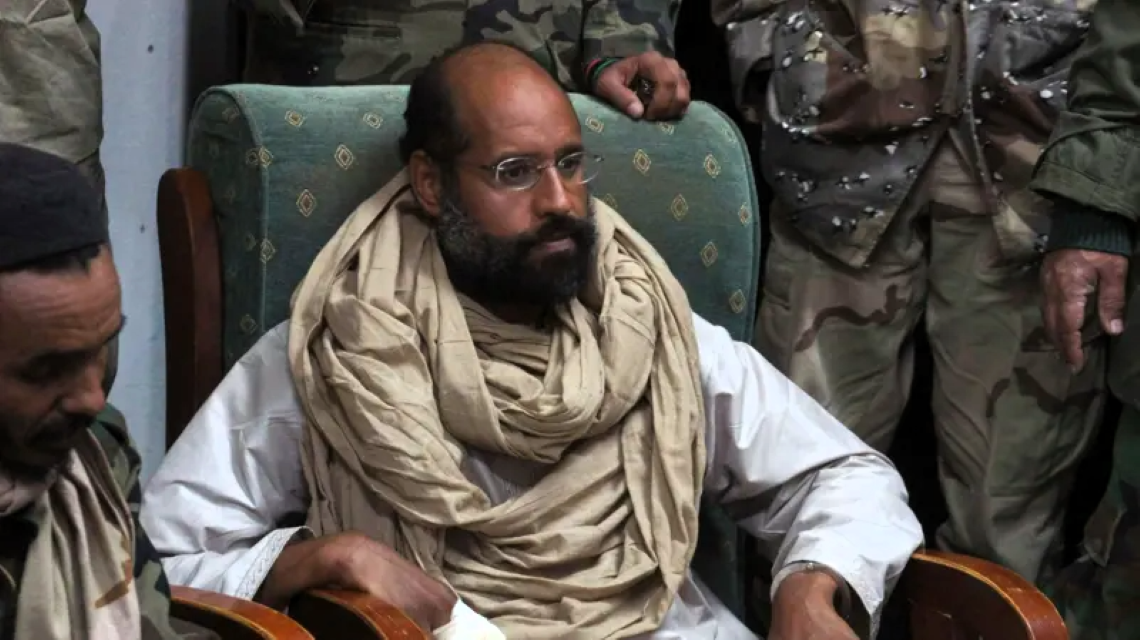
TRIPOLI, Feb 3 – (SCANS) – Saif al-Islam Gaddafi, the most prominent son of late Libyan leader Muammar Gaddafi and his one-time heir apparent, was killed on Tuesday in an armed attack in the western town of Zintan, his lawyer and political advisers said.
He was 53.
The circumstances of the killing remained murky, but sources close to his family and his political team told regional media that four gunmen stormed his residence in the early hours of Tuesday morning. According to a family source cited by Al Arabiya, the assailants disabled security cameras before shooting him in the garden of his residence and fleeing the scene.
“Saif al-Islam has fallen as a martyr,” his cousin, Hamid Gaddafi, told the Al-Ahrar network.
His political adviser, Abdullah Othman, confirmed the death in a social media post but did not provide immediate details on the identity of the attackers. Libyan state news agency LANA also carried reports of his death, though there was no immediate official statement from the country’s rival governments in Tripoli or the east.
Saif al-Islam had lived in a state of semi-secrecy for over a decade. Captured by Zintan-based fighters in November 2011 after the NATO-backed uprising that toppled his father, he was eventually sentenced to death in absentia by a Tripoli court in 2015 for war crimes.
However, the Zintan militia that held him refused to hand him over to authorities in Tripoli or to the International Criminal Court (ICC) in The Hague, which had issued a warrant for his arrest on charges of crimes against humanity.
Reformer to Rebel
Educated at the London School of Economics and fluent in English, Saif al-Islam was once viewed by Western capitals as the reformist face of the Gaddafi regime. He played a key role in negotiating the end of Libya’s weapons of mass destruction program and compensation for the 1988 Lockerbie bombing.
His reputation as a reformer evaporated in 2011 when he appeared on television to warn protesters that “rivers of blood” would flow if they did not cease their uprising, subsequently becoming a central figure in the regime’s brutal but ultimately failed crackdown.
After years in the political wilderness, he re-emerged in 2021 to register as a candidate for Libya’s presidential elections. While his candidacy was a lightning rod for controversy, the elections were indefinitely postponed amid legal disputes and a breakdown in the political process.
His death, if confirmed by independent authorities, removes one of the most polarizing and significant figures from Libya’s fragmented political landscape, potentially shifting the balance of power between the myriad factions still vying for control of the oil-rich North African nation.
(Reporting by Scans Tripoli bureau; Writing by Yazeed Abu Ummu; Editing by Mo SAni Aliyu)